Friday, August 23, 2013

In Praise of Bookshelves

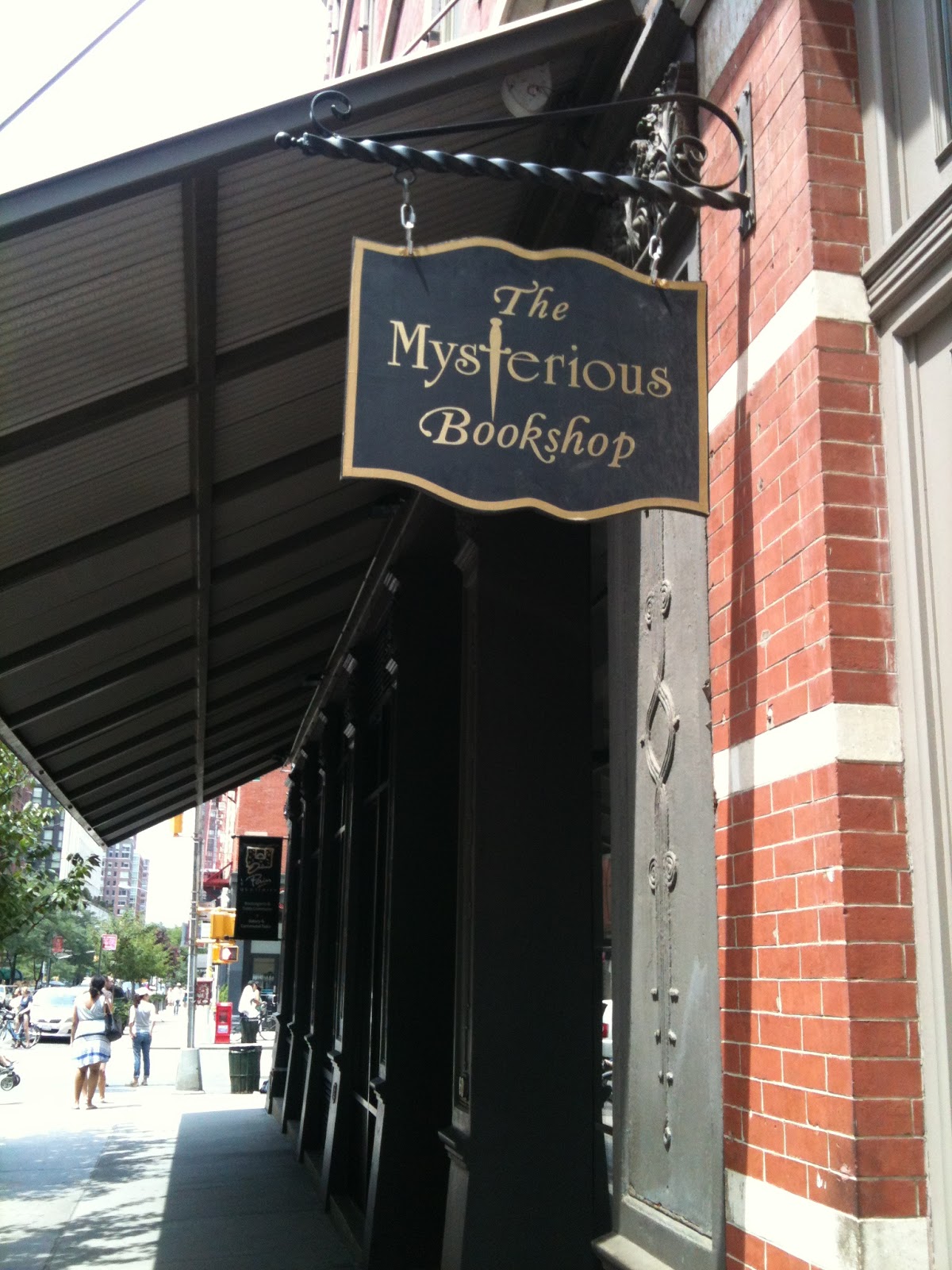
One year I combined my annual weekend in New York with ThrillerFest, a conference for writers of (you guessed correctly) thrillers.  A few presenting authors signed books at a store called The Mysterious Bookshop.  I fell in love with it, and now whenever I go to New York, I visit.

I love paper books.  I say this as an author who has published e-books and loves her Kindle.  My perfect vacation involves a chaise lounge, a view of the ocean, and at least ten books.  The Kindle lets me bring all those books in one small device. 

But my bookshelves remind me where I've been and what I've learned.  One shelf houses investment books, another is full of advice on fiction writing.  Hardback mysteries -- most of them by Sara Paretsky and John Sandford -- fill another.  Other shelves hold books on women and religion, law, happiness, poetry, horror.  When I visit people's homes, the books on their shelves spark conversation and sometimes camaraderie.  Eyes may be windows to the soul, but so are bookshelves.

My books make me feel solid and safe in a way I can't explain.  Three years ago I moved into a new two-bedroom condo.  I love it, yet even after I'd rearranged the furniture, hung artwork, and framed family photos it felt like a hotel.  A nice, relaxing hotel, but still a hotel.  Then I stacked the books I'm planning to read next on a living room table and moved two bookshelves out of my study and into my hall.  I already had books in a basket in the bedroom, so now books live in every room.  And, at last, I feel at home.

Which is how I feel in The Mysterious Bookshop.  Its bookshelves stand so tall you need a ladder to reach the top.  A leather couch and armchairs form a seating area where I usually spend half an hour reading.  Based on employee recommendations, I've found books that fall more into the literary genre than mystery or thriller, but I've loved them.  (Recent finds include You Are One Of Them by Elliott Holt and The Borrower by Rebecca Makkai.)  I always buy at least a couple hardcover books there along with my stack of paperbacks because I know I'll keep those on my shelves at home.

So here's to as many forms of books as possible and, even more, to bookshelves.


Monday, August 5, 2013

GIRLS GONE GORE

Friends,

Just a quick post to say that if you're attending Wizard World Chicago Comic Con Friday 8/9, please stop by the panel GIRLS GONE GORE! at 6.pm. central time.  Fellow (or, rather, sister) horror author Carrie Green and I will discuss horror and femininity; the role of women in horror films and fiction; as well as how to write, publish and market horror eBooks, whatever your gender.

Our bios are below.  And check out our cool logo!


Lisa M. Lilly is an author and attorney.  Her thriller The Awakening is an Amazon occult and feminist bestseller.  The title story of her short story collection The Tower Formerly Known as Sears and Two Other Tales of Urban Horror was recently made into a short film under the name Willis Tower.  Her poems and short fiction have appeared in numerous print and on-line magazines, including Parade of Phantoms, ChickFlicks, and Hair Trigger.


Carrie Green is a Marketing, Social Media and PR pro.  Her media hits include BusinessWeek, CFO,CIO, Chicago Tribune, Chicago Sun Times, Computerworld, Crain's Chicago Business, Entrepreneur, Fortune Small Business, Industry Standard, USA Today and the Wall Street Journal, among many others.  Additionally, she has promoted traditionally published business books from McGraw-Hill, Jossey-Bass (Wiley) and Edward Elgar Publishing.  She is the Amazon bestselling Horror author of Roses Are Red, Violets Are Blue, and Sugar Is Sweet.

Wednesday, July 24, 2013

The Bionic Woman, Buffy, and the Man of Steel

I recently saw Man of Steel.  Superman was a bit too dark for me, and the special effects struck me as overkill.  All the same, retellings and new approaches to familiar tales fascinate me.  I'm intrigued by questions such as why the storyteller chose to modify the origin story, or the mentor character's advice, or the overall theme.  Was it to fill empty spaces?  To fit with modern beliefs?  Because the storyteller always believed the "new" backstory existed but was just unspoken before?  (Unfortunately, my date's only comment on the entire movie, despite my attempts to jump start a conversation, was, "That was a nice little story."  Probably no long-term relationship potential there.)

This Superman reboot caused me to check on another reboot, one I initially didn't feel excited about -- that of Buffy the Vampire Slayer.  As most fans of the TV show -- and I am one -- know, the new movie version was to be written by a brand new screenwriter, with no input from creator Joss Whedon.  Those of us who love Joss' writing and directing had a hard time with that, and many vowed never to see the movie.  I almost felt I shouldn't see it, fearing it might take away from my love for the series.  Similarly, I was not a huge fan of the short-lived remake of The Bionic Woman series a few years back, though it was my favorite television show during childhood.  The new Jaime Sommers just didn't work for me.  By the way, did anyone else notice the similarity in names between Buffy Summers and Jaime Sommers?  I'm convinced Joss was a Bionic Woman fan, too.

Given my lack of initial enthusiasm, I was surprised to find myself feeling disappointed when I discovered the new Buffy movie is on ice.  Obviously, t's not because I expected to like the film.  Rather, after watching Man of Steel, I realized how wonderful it is that the film industry contemplated another Buffy reboot.  Buffy is my favorite woman hero, and she's already had a movie (a bit too campy for my taste, but it had some of the themes later developed in the show), a TV series, and a comic book series.  I love the idea that another reimagining of her myth is already being considered.

Think of how many times Superman has been remade.  Setting aside cartoons, in my lifetime, I saw the Christopher Reeve Superman movies, Lois and Clark, Smallville, Superman Returns (forgettable), and Man of Steel.  And I'm not even a big Superman fan.  I also watched the campy TV series Batman with Adam West, the Batman films that started off with Michael Keaton, and the more recent series of Batman movies.  (I was in an extra for one of those -- look for me at a funeral in a gray trench coat.) 

But how many Wonder Womans have there been?  I remember just one in my lifetime  -- the TV series with Lynda Carter.  The recent reboot of Wonder Woman, to be written by none other than Joss Whedon, never got made.  Despite the success of the Terminator and Alien franchises, the movie studios still seem inclined to default to male heroes.  But we are seeing more girls and women as heroes in movies -- movies that are doing well at the box office.  Katniss Everdeen in The Hunger Games, Maya Lambert in Zero Dark Thirty, and Tris Prior in the upcoming Divergent (filmed right outside my door) give me hope that film producers realize there is a vast audience for good movies about female heroes.  Which is great news for me as a reader, author, and filmgoer, as those are the types of stories I most enjoy.

So would I have trouble loving a Buffy reboot?  Probably.  But would I go see it?  Yes, yes, and yes.  How about a double feature with Wonder Woman?

______________

Lisa M. Lilly is the author of Amazon occult bestseller The Awakening.  A short film of the title story of her collection The Tower Formerly Known as Sears and Two Other Tales of Urban Horror was recently produced under the title Willis Tower.  Her poems and short fiction have appeared in numerous print and on-line magazines, including Parade of Phantoms, Strong Coffee, and Hair Trigger.  She is currently working on The Awakening, Book II: The Unbelievers.
The Awakening for Kindle: http://bit.ly/15bViBm

Wednesday, July 10, 2013

Why Do I Like Don Draper?

Warning - This Post Contains Mad Men Season 6 Spoilers

A male friend -- who isn't a Mad Men fan -- watched the Season 6 premiere with me. Afterwards, he turned to me and said, referring to Don Draper, "I don't understand why you like this character." As a writer, I always want to understand what makes a particular character compelling or likable, or both or neither. As to Don, for me, it's both. The puzzle is, why? Don Draper is a womanizer, he treats my favorite character (Peggy) badly much of the time, and he's a fraud, literally and figuratively. And yet...

Don Draper is a good friend. In many ways -- and I won't even try to count them -- Don Draper's behavior toward women is horrendous. It's not great toward men either. At the same time, when Peggy suffers a breakdown early in the show, Don tracks her down, finds her in a psych ward (or mental hospital -- I'm not clear on that), and says what she needs to hear to get back on her feet. He doesn't tell anyone where he found her, he doesn't ask what happened, he doesn't ever suggest maybe she can't handle things because she once was hospitalized. That is particularly striking given the much stronger stigma that attached to depression and mental health issues in the 50s and 60s. Don also mentors Peggy to become a copywriter despite the prevailing wisdom against women having careers. When Don realizes his artist girlfriend Midge has the potential to fall in love with someone available, he not only steps out of the relationship, he hands her the money he was going to use to take her to Paris. And Don tries to help Lane, even covering the check Lane forged and agreeing not to reveal Lane's actions. While it's not enough to save Lane, Don does it solely to try to alleviate Lane's embarrassment, not because he expects a return favor. 

Don Draper loves his work. One of the first times we see Don, if not the first time, he's drinking in a bar, and he's working. Not in the sense of reviewing or creating ad copy or debating points with colleagues. He's asking a server about how that man feels, what he thinks, and why. Whenever Don Draper talks with anyone or does anything, it somehow later factors into a pitch to clients. I suspect part of why Don loves his work is that deep down he longs to understand people, and he's found a business where he's rewarded when he's able to do that. Which may also be why he's most honest when he's pitching. Sometimes it hurts him (as when he tells a client the real reason he loves Hershey Bars), but usually it's why his ads resonate with people. He excels at expressing what people want and need but didn't know they wanted and needed. I can't help liking a character so good at what he does and who loves doing it.

Don Draper keeps trying. I find Don's mix of self-deception and self-analysis fascinating. His whole business focuses on tapping into people's needs and desires, especially the unconscious ones. His ads also often stem from his own desires and experiences. So on some level he always engages in self-analysis, understanding what motivates him and therefore other people. Yet, when we first see him, Don spends little, if any, time questioning why he cheats on Betty, whether that's right, or what that does to both of them. Still, Don inches toward self-awareness and change. He forms two on-going honest relationships with women -- with his first wife Anna and then with Peggy. (Interestingly, two women he never sleeps with, which suggests to me his issues are less with women and more with sex.) He also tells Faye the truth about who he is. Ultimately, he veers toward Megan, who initially seems more willing to accept him without question. But even that isn't a complete step back, as he does tell Megan the truth about himself. He also plans to be faithful to her, and is faithful for some time, most likely longer than he ever was to Betty. That he goes back to his old ways isn't admirable, but it is realistic. Change is difficult, and most people don't even attempt it. Don Draper does. He tries, he fails, he slips back, yet he tries again.

I wouldn't want my son, if I had one, to grow up to be Don Draper. Nor would I want to be his wife or his girlfriend (well, OK, maybe for one trip to Paris, but that's it). I wouldn't want him for a boss for much longer than Peggy did. But as a friend or colleague, he'd be fascinating to spend time or work with, and he'd come through in a crises.

And, yes, I like him.

---------
Lisa M. Lilly is the author of Amazon occult bestseller The Awakening.  A short film of the title story of her collection The Tower Formerly Known as Sears and Two Other Tales of Urban Horror was recently produced under the title Willis Tower.  Her poems and short fiction have appeared in numerous print and on-line magazines, including Parade of Phantoms, Strong Coffee, and Hair Trigger.  She is currently working on The Awakening, Book II: The Unbelievers.


Thursday, June 20, 2013

Pride, Prejudice and Roses

As most Jane Austen lovers know, Pride and Prejudice was originally called First Impressions because it dealt with Elizabeth Bennett's first impressions of Fitzwilliam Darcy.  Miss Bennett's views undergo a significant change throughout the book, even as Mr. Darcy alters himself to some extent due to her criticisms.

Shakespeare also addressed first impressions.  Juliet said that a rose by any other name would smell as sweet.  She was illustrating that only Romeo's family name was her enemy, not Romeo.  While this rang true for Juliet, it didn't for her and Romeo's community.  Other people's perceptions regarding what the family names and legacies meant caused great tragedy for the young couple.

It would be wonderful if most people were more like Eliza Bennett and thoughtfully reconsidered their first impressions, including those based on names or labels.  The reality, though, is we often don't get a second chance.  Labels matter, not just in literature but in life.  How we name or label things and people, including ourselves, often is not just the first but the only impression that stays in others' minds.  

As an attorney, I usually defend corporations.  But if I can help it, I never call my client "the defendant."  It doesn't sound warm and fuzzy.  Instead, I usually use a shortened version of the company name.  The lawyer on the other side is much more apt to write and talk about "the defendant," "the big corporation" or "the company" on the other side of the courtroom.

When I started my own law practice five years ago, I noticed that other lawyers and businesspeople reacted differently depending how I described what I'd done.  If I said I'd become a solo practitioner, which means a lawyer who practices without other partners or associates, people almost invariably made jokes about me starving and asked if I worked from home.  I wasn't and I didn't, but it sounded defensive if I pointed that out.  On the other hand, if I said I'd just started my own firm, people looked impressed and asked where my office was and whether I was hiring.  That made a much better start to the conversation.

Likewise, people are much more excited if I say that my thriller The Awakening is an Amazon Occult Best Seller, or even if I say I independently published it through Amazon, than if I say it was self-published.  All three things are true, but each conjures a different image.  The first sounds the most successful and exciting.  The second sounds brave and entrepreneur-like (to create my own word).  The last evokes a vision of poorly spelled stream of consciousness sprawled across a page -- or in today's world, an e-reader -- that sold twenty copies to the author's friends.

The words we use to describe ourselves and our endeavors matter not only to how people perceive us but to ourselves.  Some of the best advice I ever got was from a business development coach at my old law firm.  He encouraged me to tell my clients about my creative writing because he thought they'd find it interesting, and it was something they'd remember about me.  I was hesitant because I felt sort of apologetic about it.  I'd had some articles, short stories, and poems published, but also had gotten stacks of rejection letters for my five unpublished novels.  (The Awakening is the sixth novel I completed.)  The coach said to me, "Lisa, you are telling yourself this story that you're not successful because you haven't gotten a publishing contract for a novel.  You don't understand how few people who want to write have finished anything, let alone a novel, let alone submitted anything for publication or had something published.  Stop focusing on what you haven't done and instead focus on what you have."

He was right.  Not only did clients react positively when I spoke about my excitement about writing and what I'd accomplished, I felt better about it too.  Just like I feel more accomplished and professional when I tell someone I run my own firm.

What names and labels do you use to describe who you are and what you do?  Are there other more positive words that would create a better first impression?  If you're a rose, let people know!


Lisa M. Lilly is an attorney and author of Amazon occult bestseller THE AWAKENING, short story collection THE TOWER FORMERLY SEARS AND TWO OTHER TALES OF URBAN HORROR, and numerous poems, short stories, and articles.  She is currently working on THE AWAKENING, BOOK II: THE UNBELIEVERS.


Follow her on Twitter:  @lisamlilly

Read sample chapters of The Awakening:  http://amzn.to/pFCcN6


Saturday, June 15, 2013

Three Things I Learned From My Father

Those of you who've read my DUI loss blog know that my dad died in a tragic way -- he and my mom were hit by a drunk driver, which led to both their deaths.  But I was lucky enough that my dad lived and was happy and healthy until he was nearly 89.  This year would have been his 95th birthday.  In honor of him, and of Father's Day, I'm writing on both blogs about three things I learned from him over the years.

Focus on what you can do.  Soon after I was born, my dad had a serious back injury and needed to be off work for more than a month.  But he never talked about how much pain he'd been in, instead, he told me how he'd enjoyed getting to be home with me when I was a baby.  (Dads didn't do that very often in the 1960s.)  When I was eight or nine, he had an even more serious back injury that required surgery and left him with a partially paralyzed leg and on-going back pain.  He had to retire ten years early.  He also had to stop doing many of the things he enjoyed, which was hard because he was a very active person.  But he didn't complain.  He pulled out his old aeronautics engineering books from college and spent the next two years designing his own airplane.  Later he built one of the wings out of scrap wood.  I still have part of it hanging on my wall.

Get involved.  For as long as I can remember, my mom and dad belonged to and volunteered with Amvets.  (My dad was a World War II aviator.)   Every third Wednesday night, right up until the week before the crash, my parents loaded their car with soda, no-sugar bakery, and bingo cards and took them to the blind ward at Hines Veteran Hospital.  Amvets members and volunteers helped the patients with their cards, and Amvets provided small cash prizes.  When my brother Tim and I were playing music, my parents organized groups of musicians to put on free concerts at the hospital.  My parents also became involved in a local citizens group to help stop corruption in village government, were volunteer literacy tutors for many years, and well into their eighties gave rides to people who could no longer drive to doctors' appointments, on errands, or to church.  My dad never told us we ought to volunteer, and I never felt he thought it was a big deal.  It was just part of who he was.

Think for yourself and respect others.  My dad always taught us we shouldn't assume whoever was in charge -- teacher, boss, president -- knew what she or he was doing or had all the answers.  If we thought someone in authority had the wrong facts, we should do the research ourselves to find out what was correct.  If we disagreed with a supervisor's viewpoint, we should stick to our own opinions if we believed them well founded.  He didn't hesitate to say an idea made no sense or a statement was wrong if he thought it was, no matter who said it (which perhaps didn't make him too popular with his bosses).  At the same time, my dad also taught us to treat everyone with respect.  He might question authority or criticize an idea, but I never heard him call anyone names or address anyone by anything other than the proper title.  And even if he had questions about someone's character -- for instance, a politician convicted of embezzling money -- he would say, "I don't understand why someone would do something like that," or "that's a terrible thing to do," rather than saying that person was a bad person.

I'm grateful to have had my father in my life.  I know many people who lost their dads early in life or had fathers who weren't there or who perhaps did more harm than good.  The main way that I try to honor my dad is by speaking at victim impact panels through the Alliance Against Intoxicated Motorists (AAIM) to first-time DUI offenders.  My hope is that by sharing what happened to my parents and our family due to someone else's choice to drink and drive, at least a few other people will make a different choice, and other deaths and injuries will be prevented.  I think my dad would appreciate that.

Please feel free to share thoughts about your dad below.


Lisa M. Lilly is an attorney and author of Amazon occult bestseller THE AWAKENING, short story collection THE TOWER FORMERLY SEARS AND TWO OTHER TALES OF URBAN HORROR, and numerous poems, short stories, and articles.  She is currently working on THE AWAKENING, BOOK II: THE UNBELIEVERS.


Follow her on Twitter:  @lisamlilly

Wednesday, May 8, 2013

Will Work for Free


Nearly every artist, professional, and entrepreneur struggles at some point with whether to offer work for free. Law students often volunteer at legal services clinics. Sometimes they even pay tuition to do so. Authors and publishers offer some books free to obtain reviews and get the word out. Businesses send promotional items. (My favorite is a pen I received free with my law firm name on it and a flashlight at the end – not that I’m starting to find it hard to read menus in dim light or anything). Knowing when to work free and when to hold out for pay, especially when starting a new career or venture, can be a challenge.

When I was sixteen, I aspired to be not an author or lawyer but a singer-songwriter. My friend and mentor, Mark Dvorak, who went on to make a living as a folksinger, gave me solid advice on when to work free. Though I ultimately didn’t pursue music as a career, I’ve found Mark’s rules helpful throughout my professional life. No doubt Mark stole the rules from someone else, but I hear that’s part of the folk process, so I’m guessing whoever originated them won’t mind my giving Mark the credit. Mark told me there were only three reasons an aspiring professional ought to work free: (1) to gain experience; (2) to gain exposure; or (3) to gain potential future paid work.

(1) To Gain Experience: There’s a reason most authors, myself included, have a stack of unpublished novels in a trunk or on their computers, why aspiring doctors spend years studying medicine, and why beginning musicians jump at the chance to perform before live audiences for nothing. My cases tend to be large class actions that take a long time to get to trial. So despite having practiced law for years, when I can fit it in, I try cases with a criminal lawyer I know. Working one or two days free now and again is worth it to me to sharpen my trial skills. (Also, it’s fun.) Similarly, when I started submitting short stories to literary publications, I didn’t care whether I got paid. Seeing how my work looked in print and getting feedback from editors and readers helped me learn about writing and marketing.

Offering published books free provides good marketing experience for independent authors. If your downloads are few, your cover, book blurb, or sample pages may need polishing. You also may need to vary the days you run promotions. When I offered my occult thriller The Awakening free during 3 weekdays after Christmas, I had fewer than a thousand downloads. Over Halloween weekend, though, nearly 7,000 people downloaded the book, and on the Friday and Saturday before Easter there were about 4,500. As I otherwise did all the same things (same cover, same blurb, same marketing tweets, listings in the same venues), I’m certain the difference was due to weekends versus weekdays and to the Halloween tie in.

Knowing when you really aren’t getting experience: There are times you don’t need further experience or won’t get it from working free. To go back to my music example, if you’ve played several times on stage in front of a hundred people, and many times in small coffeehouses, you don’t need to play at your neighbor’s barbeque free just to get some practice in front of a crowd. Along the same lines, I write and argue a lot of appeals in my practice, so while I will do a short trial to gain more experience, I don’t handle appeals free.

(2) To Gain Exposure: Offering a service or product, even a good one, isn’t enough to generate paying work if no one knows who you are, what you do, or whether your work is any good. That’s why businesses, professionals and artists often offer a limited amount of work or product free.

For indie authors, this usually means offering free sample pages, or even an entire book free for a limited time. Enough free downloads can put the book on one or more Top 100 free lists. For instance, The Awakening reached No. 1 on Amazon’s Free Horror and Free Occult lists. Following that, more than 100 people put the book on their Goodreads shelves, which was one of my goals, and it gained about 25 additional reviews. This exposure led into category 3 – future sales – as well.

For medical, legal, or other professionals, working free on occasion can also provide exposure. Speaking at seminars, getting featured in articles or writing them, and networking at business events all help people become familiar with your name. It may not result in business right away, but if someone recommends you, it helps if your name already sounds familiar.

When you’re really not getting exposure: Going back to the neighbor’s barbeque (not a good example for me, because I live in a condo, but still), if everyone there has heard you play and sing before, performing there for free does not get you exposure. Similarly, as an attorney, if you’re looking for work defending doctors against malpractice suits, it’s unlikely taking on your neighbor’s employment discrimination claim for free will bring you the type of exposure you need, especially if your neighbor’s work has nothing to do with medicine. Another thing to be aware of is that free sometimes results in negative exposure. If I know little about employment law but try to help my neighbor for free, it’s unlikely I’ll have the time or knowledge to do the type of job someone who concentrates in, and gets paid for, employment law would do. Worse, I could make a serious mistake and commit malpractice, which now harms my neighbor and my reputation, to say nothing of a possible lawsuit. (“But I did the work for free” is not a defense.)

(3) To Gain Future Paid Work (or Sales): As a musician, even once I started getting paid, I sometime played free at festivals because proprietors of coffee houses and clubs who hired musicians might see me. That’s a great example of working free to gain potential future work. In the writing world, free days can lead to sales. Following my last free days for The Awakening, there were enough sales for it to stay in the Top 100 Occult books on Amazon for nearly a week. Before that, the longest the book stayed on that list was two days. Right now, it’s off the list, but it’s still considered a best seller, and that helps future sales. On the other hand, I’ve been neglecting the marketing of my short story collection The Tower Formerly Known As Sears And Two Other Tales Of Urban Horror and it’s never been on any Top 100 paid list. So I’m hosting two free days this Saturday and Sunday (May 11 and 12, 2013).

When I started as a lawyer at a large firm (not the one featured in The Tower, of course, or I might not have survived), I attended client meetings whenever I could, even if I couldn’t bill for the time. Often, the “free” meeting led to the client asking me to do paid work, and many of those clients still send me work today. That’s why I’ll provide free consultations to existing clients if they need some one-off research or advice, even if it takes a few hours.

It’s also worth giving advice free to other lawyers on occasion.  When I started my law firm, a business colleague introduced me to a lawyer who’d started her own practice years before. Rima met me for coffee and spent over an hour telling me what she’d learned about computers, billing software, business development, and finding good employees. When I realized I didn’t want to handle the various filings required by the state and federal government for starting and maintaining a law firm, I called Rima and hired her to do it. I’ve also referred other small business owners and lawyers to her over the years.

How to know when there is no potential for future sales. When I started my practice, I used to talk with anyone who called for up to forty-five minutes if it sounded like a matter that might be in my field. Unfortunately, most of the people were looking for a lawyer who would handle an entire case free or guide them while they handled the case themselves, which is something I don’t do. Now when people call cold, after the first ten or fifteen minutes, I let them know that I’m happy to talk a little further at no charge, and even review basic documents to see if I can help, but if it turns out they want me to represent them, my fee is $___ per hour and I will need an up front retainer of $____ (usually my hourly rate times 10). At that point, most people say they are looking for someone to handle the whole matter free, and I refer them to a legal aid society. (I do some volunteer legal work, but only related to non-profit entities I’m involved with.)

Another downside of free is that people don’t tend to value something they don’t pay for. Every lawyer I know has experienced this. The acquaintance who asks if you can provide free legal advice is far more likely to forget to show up for the appointment, or reschedule repeatedly, than the paying client, even if you don’t typically charge a cancellation fee. Likewise, most authors I know find they get more negative reviews from people who get their books free than from those who buy them. When you think about it, if you don’t value your time or product, why should the other person? Many recipients on some level feel that if something is being given away, it can’t be worth much. That’s another reason it’s wise to limit free offers to a sample size, introductory consultation, or a limited number of days.

I hope the above guidelines are helpful in deciding when or whether to offer your work free. Comments about your experiences are welcome.

-----------------
Lisa M. Lilly is an attorney and author of Amazon occult bestseller The Awakening, short story collection The Tower Formerly Known As Sears And Two Other Tales Of Urban Horror, and numerous poems, short stories, and articles. She is currently working on the sequel to The Awakening.

The Tower Formerly Known As Sears And Two Other Tales Of Urban Horror will be free 5/11 and 5/12 at http://amzn.to/nSGpew

Visit The Awakening on Amazon: http://amzn.to/pFCcN6