Showing posts with label books. Show all posts

Wednesday, September 28, 2016

Still Loving Books In The Digital Age

My hallway being taken over by books.
I've always loved books. But I have to admit, now that there are now so many television series that tell season-long stories, it sometimes cuts into my reading time. (Recent favorites: Agents of Shield and Jessica Jones.) I enjoy watching a good series almost as much as I do reading books.

Why only almost? It has to do both with loving to read words on a page (or an ereader) and with how loud the world seems to have become.

A cheap vacation


Reading a good story, watching a TV series, or sitting in the dark in a theater to see a movie or play all can pull me into a different world for hours. But books add a layer by, ironically, doing less. Reading requires engaging my own imagination in a way that a movie or series doesn't. I picture how the characters look, hear the sounds, and smell the scents the author describes. Because I'm so absorbed in imagining, it feels like I'm getting a cheap mini-vacation from life.

Focus


Reading a book also demands complete attention. I can and do listen to audiobooks and podcasts while doing other things. I really like that. Good audio can make you look forward to routine tasks like sorting laundry. But it also means that we're all dividing our attention more and more. In contrast, when I read a good book, I focus on it. For the first five minutes, especially with a new book, that can be a challenge. But after that, everything else leaves my mind. I truly relax. I notice I sleep much better if I read 45 minutes to an hour before I go to bed. It seems to clear out the day's concerns, almost like a long meditation.

Quiet


So many things compete for our attention these days and they're all loud. TV commercials, video clips (and more commercials) on the Internet, and cars honking is if that will make traffic jams magically disappear. Books, whether on paper or on my Kindle, don't yell. They don't shriek. They don't even whisper. They are silent. And I love that.

What about you? What do you love about reading?

Wednesday, April 13, 2016

It Was The Best Of Books, It Was The Worst Of Books: Americanah


Why I Read Americanah


Suspense, thrillers, mystery, and occult are the genres that make up most of my to-read stack, so Americanah by Chimamanda Ngozi Adichie is not the type of novel that typically catches my eye. But I saw it listed in an article covering the ten most-talked-about books for 2014 and suggested it for one of my book groups. Also, I loved the audiobook sample on Audible. It was from the point of view of Ifemelu, a Nigerian woman who moves to the U.S., struggles to achieve professional success, and writes a blog on race for non-American blacks. I found the partial blog post included in the sample funny and insightful. I was also intrigued that Ifemelu planned to return to Nigeria and was contacting Obinze, a Nigerian man whom she'd once loved, but who was now married to someone else.

The book, which I listened to rather than read, shifts between Ifemelu and Obinze, who at one point emigrates to England but does so without documentation. (Ifemelu comes to the U.S. on a visa.) There are also shifts in time. While Americanah starts when Ifemelu decides to move back to Nigeria, much of the book is the story of her life leading up to that point. 

The Best Of Books


Though I usually prefer a more traditional plot structure, I loved this book. I had no trouble following the point of view and time shifts, which is partly a testament to the narrator. She varied her accent and voice slightly for each character so that I could tell who was whom, but never to the point of caricature. I also found it fairly easy to follow the shifts in time, as the author used certain anchor scenes and places to signal the timeframe. The characters struck a chord in me and were well developed. I loved Ifemelu's observations on race and U.S. culture from her outsider perspective and enjoyed her wit and humor. At the same time, her story is deeply emotional, as is Obinze's. The book has a great deal to say about race, immigration, and differences from person to person and country to country, but I never felt it spoke at the expense of the characters or the plot.

The Worst Of Books?


So why does my title include "the worst of books"? Because after I'd finished I checked the reviews on Goodreads. To my surprise, the first review that popped up was from a reader who hated everything about the book that I'd loved. He'd found the characters underdeveloped, the plot hard to follow or non-existent, the structure lacking. Another reviewer found the book preachy and not at all funny, and the scenes that made me cry left her cold.

You Decide


None of the negative reviews changed my view of Americanah as one of the best books I've ever read. But the unfavorable reactions were educational. As both a reader and writer, I know book lovers often differ widely in how they see a particular novel. This is particularly so when it comes to a fan of literary fiction reading commercial work and vice versa. This difference often occurs because people come to novels for different things. The lovers of literary fiction tend to focus more on the writing as an end in itself, while those who love commercial fiction often look more for story, including plot and characterization. But I hadn't realized how much of a difference of opinion there could be on a book that seemed to me to do an amazing job on both counts.

If you decide to read the Americanah, please let me know how you see it.


Tuesday, September 29, 2015

Rediscovering Bliss--At The Library

The other day I rode an escalator to the seventh floor, literature and fiction, at the Harold Washington Public Library in Chicago and felt bliss. It was the second time in as many weeks I'd visited there. This made me happier than I can say because that's more visits to a public library in two weeks than I've made in the entire last decade.

For as long as I can remember, I've loved libraries. At five years old, I got my pinkish orange children's card at the Brookfield Public Library. I was so excited at the idea of this giant (as it appeared to me then) room full of books. My mom set a limit of five at a time, probably the most she figured I could carry home or possibly keep track of. It was not cheap to pay for lost library books.

The Winter Garden at the Harold Washington Public Library
Back then, the Brookfield library had two levels. You walked up concrete steps outside into the main library, then down carpeted stairs to the basement children's library. I loved the children's librarian and talked with her every time I went in. The first time I returned books I thought I should put them back where I’d found them, so I dutifully reshelved them. Mrs. Peters explained that they needed to be checked back in. (I like to think she was pleased that I had placed them on the correct shelves.) You got your white adult card when you turned twelve. Graduating to the main library floor was both exciting and sad. I'd visited the children's library once or twice a week all throughout grade school. In sixth grade, I'd moved on to the young adult books shelves, which were still in the basement. I suspect many of those now would be considered middle grade books, because the subject matters were fairly tame. Much of what was truly young adult literature was classified as adult literature at the time, including Judy Bloom’s novel Forever. (It was controversial because it showed an eighteen-year-old woman having sex for the first time without suffering negative consequences. Books where teenagers got pregnant and had to go away somewhere and have the baby in secret were allowed on the young adult shelves.) In the main library, I discovered my first Mary Higgins Clark novel on the paperback racks. That in itself was new to me, because all the children's books were in hard cover.

------------------------------------------------------------------
Click here to Join Lisa M. Lilly's Readers Group and receive
Ninevaha short horror story published exclusively 
for subscribers, free.
------------------------------------------------------------------
About six or seven years later, the library was torn down. A new one, all on one level and wheelchair accessible, was built. The projected cost of putting in the elevators and ramps had almost matched building anew, which is why the original library wasn't preserved. The new one was clean and modern, but I missed the old worn carpets and the feeling of descending into an enchanted world when going down the narrow stairs to the basement. The new children's section, where I occasionally checked out old favorites, was just another room, which was made even clearer when Mrs. Peters retired. Still, in my mid-twenties, one of the more difficult times in my life, I visited the library often. I had been working at temp and secretarial jobs, as I was a good typist, and writing fiction and playing guitar on the side. I developed a repetitive stress injury in my wrists and hands. The surgical options were not good. I stopped working and moved back in with my parents, feeling like a failure. Bouncing back to mom and dad was fairly unusual at that time, unlike now. In the evenings, I paged through career books in the library searching for something else I was qualified to do that didn't require a lot of keyboarding and that called for a bachelors degree in Writing/English. (Eventually, I attended a graduate program to earn a paralegal certificate. That later led to my becoming a lawyer.)

During that same decade, I lived on and off in another near west suburb that had a beautiful old library overlooking the Des Plaines river. Its enclosed three-season porch became my favorite place to read in the summer and spring. In the winter and fall, I researched at library carrels in front of leaded glass windows overlooking the river. I discovered some new favorite authors as I wandered the stacks. Since most of the books were hardcover library editions, I pulled them based solely on title. It is there I found my first Sara Paretsky book about female private eye V.I. Warshawski. I've read every one since. (For why, see Why I Love VI.)

Right before I started law school, I moved to downtown Chicago. For four years, I worked full time while attending school at night. I had little chance to read fiction, but I visited the Harold Washington Public Library once or twice for research. I found it cavernous and without warmth. Built from 1988 through 1991 and designed by architect Thomas Beeby, the Harold Washington is the largest public library in the world. It houses over six million books plus historical collections of Chicago artifacts. Its top floor is the Winter Garden, with a skylight and lots of marble. For all that, I've never loved the library as a whole. Its double high ceilings and sprawling undivided floors make the number of books look skimpy, and I've yet to find a cozy place to read. On most floors, the lighting is harsh, and there are long library tables with wooden chairs, but no arm chairs or couches.

Partly because of that, even after finishing law school, I rarely went there. I worked so many hours that the few times I borrowed books, I returned them late because it was hard to find time to walk the eight blocks there and back. And I didn’t always finish the books. I actually read much faster than I had before law school, but in a good week I’d have 10-15 minutes to read at night before I went to sleep. At the same time, I suddenly could afford to buy the books I wanted. Some new lawyers at large firms drastically increase their spending on clothes or cars or buy larger homes. I bought books.

That trend mostly continued when I started my own law firm. Though I went on my own to have more time to write, I quickly became nearly as busy as I had been when I was employed at Sonneschein (now Dentons US LLP). I enjoyed my practice more, because I liked running my own business and having a wider variety of responsibilities. How busy I was had more ups and downs, though. Which meant that while I had a little more time to read, that time was less predictable. I might have one or two weeks when I would get home from the office by 6 p.m. each night, so I read for twenty minutes or or so after I finished my evening’s fiction writing. There were other months when I more or less lived at my office. The receptionist used to joke that she was sure I had a cot under my desk. So my visits to the public library were still few and far between.

Then, last spring, after spending about two years gradually slowing down my law practice, I flipped my work life so that I now focus about three-quarters of my work week on writing and one-quarter on law, with lots of what I’d call writing adjacent activities, such as reading, in my free time. (I also now actually cook and eat at home fairly often rather than eating out or at my office, which has felt very nice.) So recently it occurred to me that I had time to go to the library. I remembered the Harold Washington as rather cold, too big, and not inviting. No doubt, all those things are still true, as it has not been significantly remodeled. Yet, as I rode up the escalator for the second time in two weeks, the smell of paper and aging book covers made me feel like I had come home. The rows of stacks once again offered worlds of possibility. I'd forgotten how much I loved meandering shelves perusing different titles. Now I can try authors I've never read before, because my reading isn't limited to fifteen minutes snatches in between other work. Instead, I can read uninterrupted for an hour or more sipping a cup of Earl Grey tea or a glass of Pinot Noir.

No doubt my next visit to the library and the next after that will seem less novel and amazing, and eventually it will be routine. And that in itself is wonderful. In this country more books than any one person could read in a lifetime are available for free. And while libraries have expanded to provide access to the Internet, ebooks, and numerous other services, those rows of books remain, for me, a huge part of what magic and joy are all about.
--------------------------------------------------------
Lisa M. Lilly is the author of the occult thrillers The Awakening and The Unbelievers, Books 1 and 2 in the Awakening series. A short film of the title story of her collection The Tower Formerly Known as Sears and Two Other Tales of Urban Horror was recently produced under the title Willis Tower. If you'd like to be notified of new releases and read reviews of M.O.S.T. (Mystery, Occult, Suspense, Thriller) books and movies, click here to join her email list and receive free a short horror story, Ninevah, published exclusively to M.O.S.T. subscribers.


Tuesday, September 15, 2015

The Second Mr. de Winter: What If Genders Were Reversed In Rebecca?

My lawyer book group (read more about the lawyer book group here) recently read Daphne Du Maurier’s classic, Rebecca. The book is a suspense/thriller about a young woman who marries a widower whose first wife was lost at sea. After the narrator marries Max de Winter, she becomes mistress of Manderley, a mansion in an isolated area. Roughly twenty years younger than her husband and of a different social class, she feels constantly overshadowed by her predecessor, Rebecca, and nervous around his family and staff. She is constantly told how beautiful, engaging, and personable the first Mrs. De Winter (Rebecca) was. Her husband is distant, and the narrator becomes convinced that Max never loved her but married her as a balm for his grief. The mood darkens as questions about Rebecca’s character and death emerge.

After discussing the book, I started  thinking about whether the story would change were the characters’ genders reversed. I've tried not to include too many spoilers in my thoughts below, but if you haven't read Rebecca, proceed with caution.

  • The age difference between the narrator and de Winter would be a more pivotal part of the story and would be addressed directly if Maggie de Winter, a fortyish widow, married a young male about twenty years old. As written, while a few comments are made about Max marrying a “young bride,” and the narrator’s youth combined with her social class makes her uncomfortable running Manderley, the age difference is rarely remarked upon. Further, no one questions that the narrator in Rebecca truly loves with Max de Winter. Understanding her actions at the end of the book turns on that. Readers might speculate far more about whether a young male narrator with no resources of his own married Maggie de Winter solely for her money.
  • If the first spouse were named Reginald rather than Rebecca, he might never have married. We eventually learn that Max de Winter was shocked and revolted when soon after their marriage Rebecca told him of horrible things she had done and expected to continue to do. While not spelled out, her “awful” behavior is that she was sexually active. Given the desire to continue to have multiple sexual partners, a man in the 1930s would be more likely to be able to support himself or to have inherited money or property, making it less likely that he would choose to enter a relationship that is by definition monogamous. Also, it seems more likely Reginald’s sexual exploits would have been forgiven or at least tolerated even after marriage, thus avoiding the central conflict between de Winter and Spouse No. 1. 

---------------------------------
Click here to Join Lisa M. Lilly's M.O.S.T. (Mystery, Occult, Suspense, Thriller) Readers Group and receive Ninevah,
a short horror story published exclusively for subscribers, free. 
---------------------------------

  • The issue that most enrages de Winter—that Rebecca might have a baby that is not his who would then inherit his estate—also would disappear for biological reasons. If Reginald had sex resulting in progeny, Maggie de Winter would know the child was not hers, nor would the child inherit from Maggie.
  • The underlying premise of the book would fail. Next to the opening line about Manderley, the most well-known aspect of Rebecca is that the reader never learns the narrator’s name. When she is named at all, she is the "second Mrs. De Winter." (Rebecca at least gets a first name, as well as having the novel named after her, though we don't know what her last name was before de Winter.) One of the most striking scenes to me is when the narrator answers her first call at Manderley and, when the caller asks for Mrs. de Winter, says in confusion that Mrs. de Winter is dead. All of that changes if a male narrator marries Maggie de Winter, whose first spouse was named Reginald. First, “de Winter” probably wasn’t Maggie’s name, as she no doubt changed hers to her husband’s when she married the first time. So Reginald’s first and last name become known, and Maggie’s original last name is unknown. Second, when Maggie married again, she almost certainly would have changed her last name to the male narrator’s. And if she didn’t, it’s highly unlikely the male narrator would change his to match hers. Even today, 70-80% of women in the U.S. take their husband’s last name on marriage, and I could not find statistics on how many men take their wives’ last names (so I’m guessing not many). In short, a book about a "second Mr. de Winter" would be far more likely to be about, say, the son of a president than the second spouse of an older, well-to-do woman. 
  • Finally, were the book named Reginald rather than Rebecca and the protagonist male, the book might have gotten a better reception from critics. Critics dismissed Rebecca as a romance and of no consequence. Happily for du Maurier, readers loved it, and Alfred Hitchcock, master of suspense, made it into a movie. Published in 1938, the book is considered a classic and has never gone out of print. As I write this, out of over 20 million paperback books on Amazon, Rebecca’s Amazon Best Seller rank is 4,248.

Are you interested in more discussions of books and films in the mystery, occult, suspense, and thriller genres? Join my Readers Group and receive the M.O.S.T. e-newsletter.

--------------------------

Lisa M. Lilly is the author of the occult thrillers The Awakening and The Unbelievers, Books 1 and 2 in the Awakening series. A short film of the title story of her collection The Tower Formerly Known as Sears and Two Other Tales of Urban Horror was recently produced under the title Willis Tower. 


Tuesday, June 30, 2015

Are Books Written by Women More Likely to be Labeled "Trash"?

Have you ever heard someone say with an air of apology, “I read trash”? Or has anyone dismissed what you read that way? Once a friend referred to an early Mary Higgins Clark book as trash. If Clark has heard her work called that, I imagine she doesn’t lose sleep over it given that she’s known as the Queen of Suspense, has sold over 100 million books in her lifetime, and receives advances of over $10 million per novel. But the comment made me wonder, what is it that makes one book or author more likely than another to be labeled trash?

It seems like some subjects, genres, or aspects of writing should make the distinction easy to draw, but I suspect other not so obvious factors are at work. For example, last month my women’s book group read a book I normally would never have picked up. It’s a coming of age novel told by a first person narrator. The story, to the extent there is one, revolves around sexual tastes and practices the general public considers unusual. The dialogue struck me as preposterous, and the narrative includes annoying catch phrases and repetition. All my critiques makes this sounds like a book in one of those genres that’s most often labeled trash, such as erotica or romance. Fifty Shades of Grey, perhaps. But no, what I read was In One Person by John Irving. After the book was released in 2012, Time magazine called Irving a “literary legend.”

For those not that familiar with the two novels, Fifty Shades was initially self-published as an e-book in 2011. It is about a young woman who is a virgin. Her first sexual relationship is with a man whose proclivities include bondage and discipline. In One Person was traditionally published. Written as if it were a memoir of a man in his sixties or seventies, it focuses on the narrator’s first sexual relationship, which is with a transsexual (this is the word the author uses), as well as his many subsequent sexual experiences as he matures. I did not like either book. After the first chapter, I skimmed both. The critiques I listed above I had about both books. Yet E.L. James (the pen name of the Fifty Shades author) is generally considered a writer of trash and John Irving is lauded as a literary giant.

Here are my ideas about why:

------------------------------------------------------------------
Join Lisa M. Lilly's M.O.S.T. (Mystery, Occult, Suspense, Thriller) Readers' Group and receive Ninevah, a free short horror story published exclusively for subscribers:
click here to join and receive your free copy 
-------------------------------------------------------------------

Emotional Distance or Closeness: One reason I don’t like many literary novels is that, as with Irving’s book, I often feel disconnected from the characters. While I didn’t love Fifty Shades, I had no doubt how narrator Anastasia felt about her love interest, her life, her sex life, her friends, etc. I had empathy for her. In contrast, I never quite feel what Irving’s main character, whose name I’ve forgotten, feels. His sex scenes are detailed to say the least—I’ve never read or heard anything that included so many uses of words for male and female anatomy—but, to me, not compelling. They are told with a tone of irony and detached observation. Most novels I was required to read in high school and college had that type of distance between the author’s voice and the characters. Most were written using an omniscient narrator. In that style, the narrator knows all about everything, sometimes even intruding and commenting on the plot or the characters’ choices, but stays a bit removed and above it all. Current fiction tends to set the reader right in the characters’ hearts and minds. I think this has led to associating “literature” with distance and popular fiction (which for some equals “trash”) with emotional connection. Though certainly there are literary writers, such as Dorothy Allison, whose work I find almost too hard to read due to the depth of the characters’ emotions.

Guilt/Entertainment: Many people feel guilty about enjoying reading. If a book is fun and they can’t put it down, they believe it must not have literary merit. On the other hand, if most people groan when they hear the title and say, “Ugh, yeah, I had to read that in school,” or if at the very least it takes effort and planning to get yourself to sit on the couch and open it, then a novel must be good, it must be literary. So a fast read like a Jonathan Kellerman or a Mary Higgins Clark is trash, and a novel that plods along where you don’t care one way or another about the characters must be literary. Again, I think this is a holdover from high school and college.

What the Book is About: I don’t mean the subject of the main storyline. In One Person and Fifty Shades of Grey are both about sexual awakening and experiences. But the former also explores sociological and political questions such as how the main character’s family responds to him and his orientation, what role heredity and environment may or may not play in sexuality, and how society treated and treats people who are bisexual. In contrast, for the most part, Fifty Shades focuses on the personal relationship between Anastasia and her love interest and leaves larger questions about society untouched. This is not to say that a reader couldn’t extrapolate from Anastasia’s experiences and feelings to a larger theme, but, to me at least, that isn’t in the text of the book. (Perhaps this is why I saw Irving’s book referred to as “literary porn,” while Fifty Shades is often called “mommy porn.”) This criteria is one that, for me, often divides what I think of as pure of-the-moment entertainment versus a book that makes me keep thinking about it long after I’ve finished. But I’ve felt this way about both books that are considered literary and those that are considered genre or mainstream fiction, such as certain Stephen King novels, my favorite being The Dead Zone.

The Education Needed to Read And Understand the Book: By education, I don’t mean level in school, but the breadth of knowledge a person needs to understand the book. I suspect this is a principal reason Shakespeare was considered entertainment for the masses when originally performed and is now considered literary. For most of us, enjoying Shakespeare’s plays takes a certain amount of knowledge of the times in which they were written and the changes in the language since then. That can be gained through reading an annotated text or joining literature classes or discussion groups, but it takes more effort than, say, a detective novel. So readers of Shakespeare and similar books may see themselves as smarter, more educated, and more like serious readers even if they only read a few books a year, while I tend to think of serious readers as those who love to read book after book after book.

The Gender of the Author and the Main Character: Look at any overall list of best literary fiction and you’ll find it dominated by men, and white men at that. This is starting to change, so now you’ll find women writers and writers of color included in literary book lists for recent years. All the same, being male helps if you want to be considered a serious author. Something else I’ve noticed is that a coming of age book about a young woman is generally considered a genre or young adult book (think Are You There God, It’s Me Margaret, or anything else by Judy Blume if you’re my age or the Hunger Games or Divergent novels), and thus, to some people, a lesser sort of book—a sentiment with which I disagree. A coming of age book about a young man, however, is often considered literary. Think about The Adventures of Huckleberry Finn or Catcher in the Rye. There are exceptions; for instance, I found To Kill a Mockingbird on one list of literary coming of age novels (along with 9 books about boys/men). Likewise, when women write about sexual or romantic love, by and large it is considered trash—think of the view of most everyone you know about romance or “women’s” novels. When men write about sexual exploits, though, it is literary. Ask Vladimir Nabokov and John Irving.

------------------------------------------------------------------
Would you like to receive Lisa M. Lilly's e-newsletter with M.O.S.T. (Mystery, Occult, Suspense, Thriller) book and film reviews? Your email address will not be shared or sold.
------------------------------------------------------------------

The Track Record of the Author: This is the one that probably applies most directly to the two books I’ve been comparing. Fifty Shades of Grey began as fan fiction (fiction where the writer adopts characters of an already existing book, movie, or television show) based on the Twilight series. The author was an unknown in the fiction world. Only after she self-published it as an e-book and it became wildly popular did a traditional publisher take it on. John Irving, in contrast, had twelve novels published before In One Person, for the most part to critical acclaim. Based on his pedigree, I assumed when reading In One Person that Irving deliberately chose for stylistic reasons to have the narrator retell various anecdotes and refer to his uncle and other characters a gazillion times by nicknames such as “The Racket Man.” (Or “racquetman,” I’m not sure, as I listened rather than read and didn’t care enough about any of the characters to track it down or figure it out from context.) On the other hand, knowing the history of Fifty Shades of Grey, I assumed that when the entire contract between the narrator and her love interest was included word-for-word more than once, it was because the story initially had been told in serial fashion, so the author had repeated it for readers who hadn’t started at the beginning, then not thought to edit it out when transforming the work into one complete novel. Similarly, I ascribed catch phrases that made me cringe to inexperienced writing. In short, while I didn’t like either writing style, I concluded Irving was trying to achieve an effect that just didn’t work for me, while E.L. James’ novel needed another round or two of rewriting or editing. Accurate in either case? Maybe, maybe not.

As for my own writing, as in reading fiction, plot matters to me most, then character, then the writing style, but I strive for all three to be as strong as possible. And I don’t consider anything I read “trash,” just a book or style or subject that’s not for me. What about you? Do read—or write—anything you would call trash? If so, what does that mean to you?

-----------------

Lisa M. Lilly is the author of the occult thrillers The Awakening and The Unbelievers, Books 1 and 2 in the Awakening series. A short film of the title story of her collection The Tower Formerly Known as Sears and Two Other Tales of Urban Horror was produced under the title Willis Tower. If you'd like to be notified of new releases and read reviews of M.O.S.T. (Mystery, Occult, Suspense, Thriller) books and movies click here.
                                                

Friday, November 28, 2014

What Books Are You Thankful You Read? (Favorite Books Post No. 4)

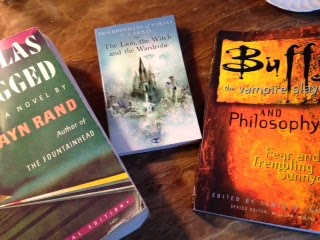
This year has been a good year, and I have more to be thankful for than I could put into a hundred posts. So, being a writer, I figured I'd narrow it down to books. Which still could take more than a hundred posts, so I decided to write about three books: one from childhood, one from college, one from the last few years.

The Lion, The Witch, and The Wardrobe

In first grade, my teacher left school for several months to have a baby, and we had a wonderful substitute teacher. Every day she read to us from C.S. Lewis' The Lion, the Witch and the Wardrobe. It captivated me instantly with the scene where Lucy hides in a wardrobe during hide-and-seek. She plunges into the furs hanging there, putting one hand out so she doesn't hit the back of the wardrobe. Instead, she finds herself in a forest with snow falling around her. I wasn't sure what a wardrobe was, but from context decided it was like a closet. After that, every closet I could get to, I felt along the back for a secret door to the land of Narnia. Similarly, I didn't know what Turkish Delight, the treat the Snow Queen gives little Edmund that only makes him long for more, was. (Okay, I still don't, so if anyone would like to fill me in, feel free). I imagined it tasted like my favorite candy, which was Watermelon Jolly Rancher hard candy, only liquid so it could be poured out of a bottle. I loved to read, and I'm sure I'd already read, or had read to me, other books that involved magical worlds, but The Lion, the Witch and the Wardrobe is the first one that stands out in my mind. Lewis' vivid descriptions drew me into Narnia. And the story gave me the sense that there were amazing worlds and possibilities just a stretch of an arm away.  

Atlas Shrugged

I came across Ayn Rand in a Philosophy 101 class. The textbook mentioned almost in passing a philosophy of enlightened self-interest that held a man's proper moral goal was his own happiness. (Ironically, that's how Rand phrased it, despite that she created one of my favorite women heroes.) My professor, when I asked to learn more, told me to read Ayn Rand's novel Atlas Shrugged, and I did. On a practical level, Rand's heroes Dagny Taggart and Hank Reardon gave me models of women and men excited and passionate about their work. Most people I knew viewed their jobs as a sort of a necessary evil, and each work week as something to be gotten through to get to the weekend. I knew few people who ran businesses or who finished college. On an emotional level, the idea that a person ought to pursue happiness changed my view of life. My mom, raised in a very poor immigrant family during the Depression, believed happiness was more likely in the next life than this one. At the time, the Catholic Church fostered that type of mindset. We were told most people needed to suffer after death in a place called Purgatory to pay for their sins. Then they could be allowed into heaven. If you suffered in life, that shortened your time in Purgatory. So my mom believed if you were too happy in life, you'd have to suffer for it later. In retrospect, I think this was her way of believing in some sort of fairness, a way to balance out that some people at least seemed to have better and happier lives than others. Atlas Shrugged gave me an alternative approach, one that said that achievement and happiness and success all fit together and that it was moral to want the same positive, good things in your own life that you believed were good for others.

Buffy the Vampire Slayer and Philosophy

I found this book while browsing in Borders one day. I love Buffy, and I'd never taken philosophy beyond the 101 class. This book seemed like a painless way to cover some of the ground I'd missed. But it turned out to do more than that. For one thing, I learned a lot about writing from it, particularly how ethics and a world view can make a story rich and layered without slowing it. Much as I'd liked Atlas Shrugged, it was as if Rand didn't trust her readers to draw the "right" conclusions, so she'd inserted treatises within the novel. Probably good for reaching someone like me who wasn't inclined to read her non-fiction cover-to-cover, but not a model of how I wanted to write fiction. Buffy and Philosophy peeled apart plots to show me how the ethics of Buffy creator Joss Whedon made the storylines stronger and the characters deeper without any preaching. The book also helped me understand my own world view and why Buffy spoke to me beyond just being a good show with strong characters. I'd long ago rejected most of Catholicism, though not the values I'd learned along the way. I struggled to articulate the source of my beliefs on right and wrong. The first essay in Buffy and Philosophy speaks to this, positing eudaimonism as the ethical basis of Buffy. Eudaimonism "holds that the basis of moral goodness is the fulfillment of human nature to its highest potential....The Buffyverse consistently reflects the Platonic view that a just person is always happier than an unjust person." (See the first essay, Faith and Plato, pp. 7-8.) The essay shows how this plays out throughout the show and in spinoff Angel, particularly through the dynamic of Buffy and Faith, initially drawn as the "good slayer" and "bad slayer."  

So those are my three books. I'd love to hear about yours, so feel free to comment below. And Happy Day-After-Thanksgiving!

-----------------

Lisa M. Lilly is the author of Amazon occult best sellers The Awakening and The Unbelievers. Her poems and short fiction have appeared in numerous print and on-line magazines, including Parade of PhantomsStrong Coffee, and Hair Trigger, and a short film of the title story of her collection The Tower Formerly Known as Sears and Two Other Tales of Urban Horror was recently produced under the title Willis Tower. If you'd like to be notified of new releases, click here to join her email listThe Awakening series is also available on barnesandnoble.com.