Thursday, September 26, 2013

From Then Until Now (Post No. 1 of Adventures in Health Insurance)

Many people in both my professions (writing and law) are self-employed and, as do I, face the on-going issue of how to pay for healthcare or obtain health insurance.  With the changes occurring due to Obamacare or the Affordable Healthcare Act, whichever you like to call it, I thought it might be helpful to share my journey.  I plan to check out Illinois' healthcare exchange on Tuesday, October 1, 2013 and will report on my progress.

I first purchased an individual health insurance policy a couple years out of college.  I had a group plan at my office job (my degree was in Writing/English, thus the office job), but I'd discovered I could earn more temping through a downtown agency and give myself the freedom to take time off to write.  I shared an apartment, lived on a very limited budget, and usually worked about 3 weeks, then took 1-2 weeks off to write, which I loved.  My limited hours meant no health insurance through the temp agency.  For less than $100/month I got a policy with a high deductible that I kept for about 4 years.  Never met the deductible.  I had no trouble qualifying, I don't even recall if the form was long or short or what questions there were, though I'm pretty sure someone came out and gave me a blood test.  A few people told me I was young so I ought to just go without coverage, and I could always get treated at the county hospital.  That sounded like a very bad idea.  One of my friends, a year younger than me, out of the blue needed emergency surgery during a brief coverage gap.  Her bill was tens of thousands of dollars, and she earned not much more than minimum wage.  (She eventually finished paying about 15 years later.)  Also, I felt that if I could afford health insurance, I should buy it, especially because I'd chosen to work less and earn less.  Unlike many people who find themselves without insurance, I could have opted to stay at my job and keep my benefits.

Fast-forward a few years, and I developed carpal tunnel/tendinitis from all the typing for work and for my own writing (and my guitar playing).  The treatment options weren't good back then, and the work comp doctor recommended working until it got really bad, then having surgery.  I researched a little, learned that many people needed surgery again when they returned to work, and decided I ought to find something else to do for a living.  It was a very rough time for me, but eventually I returned to school, earned a graduate paralegal certificate and got a paralegal job where I relied on my research and writing skills and had a secretary who did the majority of my typing.  (Not everything was computerized at that time.)  I also had health insurance with an exclusion for carpal tunnel/tendinitis, as I worked at a very small firm and the policies were more like individual than group policies.  As I'd rejected the idea of surgery, the exclusion didn't affect me too much, but it didn't make me happy.  I didn't know what I'd do if something aggravated my hands and I needed treatment.

Later I went to law school and became a lawyer at a large firm that had a group plan with Blue Cross.  Hooray!  No worries on exclusions, though I never needed treatment for the carpal tunnel while I was a lawyer, having discovered the Microsoft Natural keyboard (which I'm using right now).  Even before I went to law school, I'd had in mind that eventually I'd open my own practice.  Partly, again, so I could take time to write when I was able to afford it, and because I wanted to work for myself.  It turned out I liked the large firm quite a bit, so I stayed 8 years.  After year 6, though, I started talking to people who'd started their own firms to gather information.  One thing I always asked, given my previous experience, was what they'd done about health insurance.

Those who were married generally got coverage through a spouse.  Others practiced part-time and had a full time job where they got health insurance.  Some tried to get insurance through an organization, like a bar association or writers' association.  It turns out those types of plans are not group plans, but individual policies where the members get discounted rates.  Which means, unlike a group plan, the insurer can turn you down.  Which happened to a colleague when she opened her practice.  I was shocked, as she'd never had any health issues and had only been hospitalized when she had her children.  But she'd sought counseling during her divorce and was turned down even though she'd applied through the Chicago Bar Association (she was a member).  The carrier -- one of the major, name brand ones -- said they don't cover people who have had any type of psychological counseling.  She got insurance through another major carrier. 

I decided to use COBRA for my first eighteen months on my own, which cost over $400 a month but kept my Blue Cross PPO.  Everyone told me health insurers only look back 5 years, and I didn't see anything in the last five years that should be troubling, though I had gone to counseling for relationship issues myself before that time.  I hadn't had any major health issues other than the carpal tunnel.  My friends and colleagues thought I was crazy to be concerned.  My only medications were for allergies, I don't smoke, I exercise and am within the recommended weight range for my height, and I'd only missed perhaps 3 or 4 days of work for illness in my eight years of practice.  So I figured when my 18 months was up, I'd apply for an individual policy and I'd be set.

That didn't turn out to be the case.  But more on that next post:

http://lisamlillypad.blogspot.com/2013/09/once-i-became-self-employed-post-2-of.html

------------------------------
Lisa M. Lilly is the author of Amazon occult bestseller The Awakening.  A short film of the title story of her collection The Tower Formerly Known as Sears and Two Other Tales of Urban Horror was recently produced under the title Willis Tower.  Her poems and short fiction have appeared in numerous print and on-line magazines, including Parade of Phantoms, Strong Coffee, and Hair Trigger.  She is currently working on The Awakening, Book II: The Unbelievers.
The Awakening for Kindle: http://bit.ly/15bViBm

Friday, September 20, 2013

Anatomy of (Rewriting) a Thriller

A few people have asked me where The Awakening II is. Which makes me very happy, as I hope it means they read The Awakening. The answer makes me less happy: It's on my dining room table. That is, the first draft of it is. A second/third draft (I rewrite in pieces) is in the laptop. I should add that, actually, first I outline, which sometimes takes longer than the first draft. So I basically write from point to point in my outline, in sort of a mad dash to the end. 


During the first draft, rather than get distracted by the Internet - not that I ever am, of course - if I need to research something I put a bolded note in brackets to check it later. For instance, when I wasn't sure what the national language for Turkey was, I used "Turkish," then in brackets said [check this]. (Turns out it's Turkish.) 

This approach to first drafting means I spend a lot of time rewriting.  I start with the various plot lines. I did a Find in Word for Ray - Tara's biological father, who has a small role to play. I read each scene involving Ray in order, skipping over everything else, to make sure his story fit together, then did that for the other characters.

I'm now pretty much done with that, so my next step is to look at the overall plot to be sure it makes sense, is consistent throughout, and has high enough stakes. Next, I'll rewrite from beginning to end on the laptop, asking myself what each scene's viewpoint character sees, tastes, smells, hears, and feels (both tactile feeling and emotion). Finally, I'll look at the lines and words themselves. This includes lengths of sentences, paragraphs, chapters. Also actual words - is the same word used too many times on a page or in a chapter? Can I say anything more succinctly? As in, can I use fewer adverbs like "succinctly"?

Then I'll print the whole manuscript out, wait a couple weeks, and read it. I'll particularly look for any scene where the characters are sitting and talking or sitting and thinking. Or standing and talking. I don't cut all those scenes, but if there are a number in a row, or one is very long, I'll try to intersperse the dialogue with action.

I also look for too much action. Sometimes a reader needs a break to just breathe and be with the characters. After I've made those changes, and I feel like I'll throw up if I look at it one more time, I'll send it on to first readers. (That's Mr. Bird reviewing some of my writing. I don't always takes his suggestions, but don't tell him, he's very sensitive.)

So, not-so-short answer (I do like to write novels, after all), The Unbelievers (Book II of The Awakening series) is on its way. I'm hoping it'll be ready by Christmas, more likely it'll be somewhere between Christmas and Easter.

In the meantime, if you join my email list by 11/30/2013, you'll be entered into a drawing to have a character in The Unbelievers named after you. Just email me at lisa@lisalilly.com with your first name and say you want to be in the contest.

Feel free to join the email list after 11/30/2013 as well. No spam, I would never do that to you. Just a short monthly newsletter discussing books in the mystery, occult, suspense and thriller genres and an occasional update on new novels or short stories I publish in between. (And as you can tell, it could be Easter before you get one of those.)

Monday, September 9, 2013

Stranger Danger, Comic Con and Girls Gone Gore

Last month I  presented a panel, Girls Gone Gore, at Comic Con Chicago with author Carrie Green. The first time we met, Carrie and I talked about how both of us have had people suggest that because we write horror/suspense/thrillers, we ought to consider using our initials or male pen names. The idea that readers believe male authors more likely to write good horror is nothing new. As I learned when I researched for the panel, Mary Shelley's Frankenstein originally was published with the author listed as Anonymous. Everyone assumed it was written by a man.

Why the bias toward men still survives is puzzling considering the success of Frankenstein, as well as of works by other women horror writers like Shirley Jackson (The Lottery, The Haunting of Hill House). But something Carrie pointed out on our panel is that when women write horror, suspense or thrillers, it's often called something else. I read The Lottery in English class, and a lot of people read Frankenstein in school as well.  So these horror tales are called literature, not horror.  (I don't know why there needs to be distinction between the two, but that's a whole other post.)  Happily, when I asked the audience of about 40-50 for our panel what they thought, most did not seem to care if authors were male or female, they were just looking for good books.  One young woman said she hoped women would not use pen names or initials because she actively looks for women writers.  She believes they are more likely to develop the characters' interior lives than are men, and that's something she likes in fiction.

Another thing we talked about is the portrayal of women as victims. Based on a lot of popular movies, TV and fiction, one would think strangers are a great danger to women. Curious about how reality and fiction match, I checked the FBI website. It turns out over 75% of homicide victims are men, not women.  (There is one exception. Serial killers, who are rare in real life, are more apt to target women.)  Even more interesting to me was that men, not women, are more likely to be killed by strangers.  Women are more likely to be killed by people they know. Specifically, husbands, boyfriends, and relatives. Which led me to comment that despite what we see on TV, the most dangerous thing for a woman to do probably is not to walk down a dark alley, but to get married.

The Comic Con panel attendees, many of whom are Buffy fans (as am I), were great to talk with on this point. These readers want to see strong women characters. They love reading about and watching on film girls and women who are portrayed as three-dimensional characters in all type of roles, including as heroes.

And the more such books and films and TV shows sell, the more of them there will be.

________________

Lisa M. Lilly is the author of Amazon occult bestseller The Awakening.  A short film of the title story of her collection The Tower Formerly Known as Sears and Two Other Tales of Urban Horror was recently produced under the title Willis Tower.  Her poems and short fiction have appeared in numerous print and on-line magazines, including Parade of Phantoms, Strong Coffee, and Hair Trigger.  She is currently working on The Awakening, Book II: The Unbelievers.
The Awakening for Kindle: http://bit.ly/15bViBm


Friday, August 23, 2013

In Praise of Bookshelves

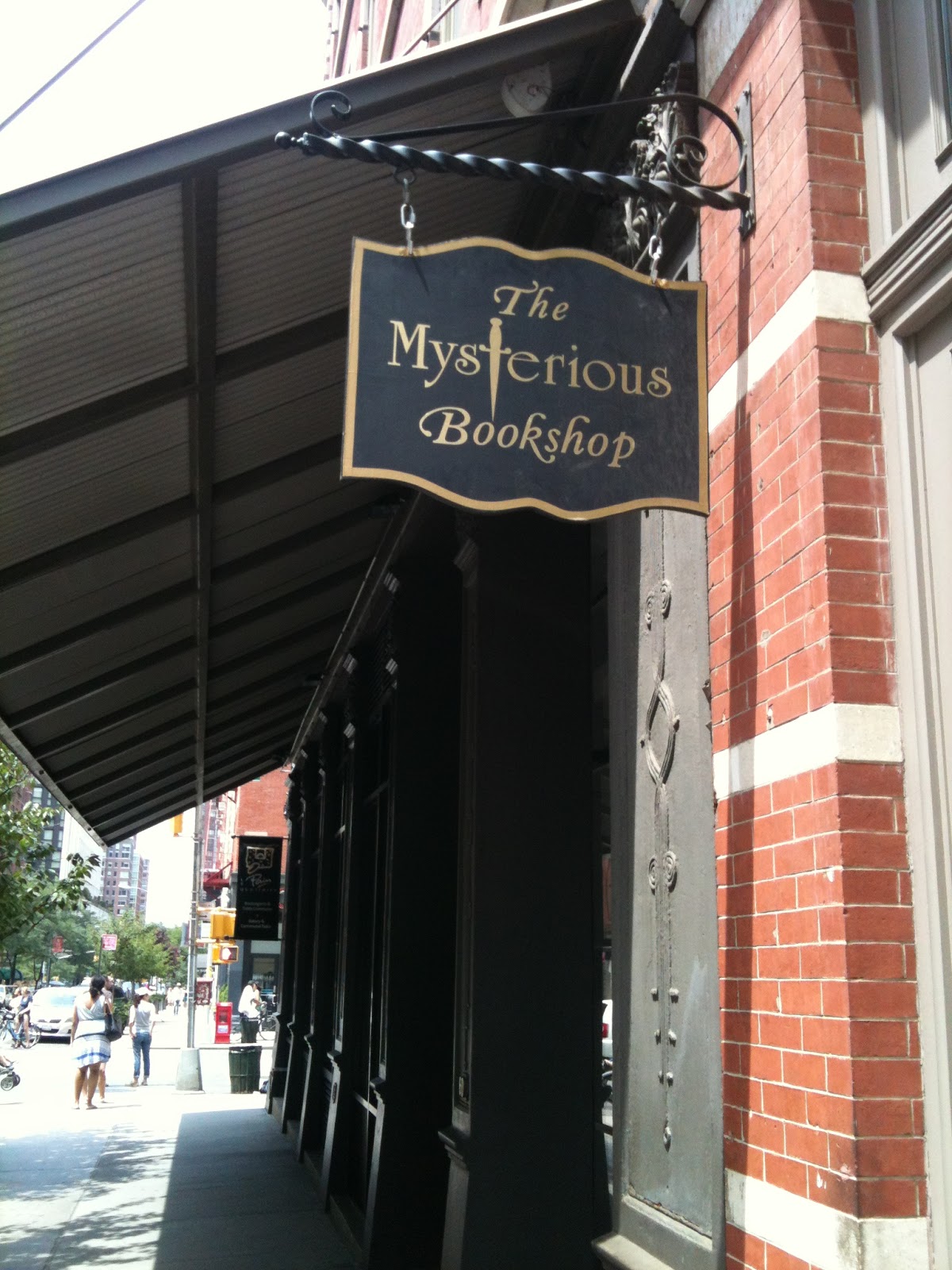
One year I combined my annual weekend in New York with ThrillerFest, a conference for writers of (you guessed correctly) thrillers.  A few presenting authors signed books at a store called The Mysterious Bookshop.  I fell in love with it, and now whenever I go to New York, I visit.

I love paper books.  I say this as an author who has published e-books and loves her Kindle.  My perfect vacation involves a chaise lounge, a view of the ocean, and at least ten books.  The Kindle lets me bring all those books in one small device. 

But my bookshelves remind me where I've been and what I've learned.  One shelf houses investment books, another is full of advice on fiction writing.  Hardback mysteries -- most of them by Sara Paretsky and John Sandford -- fill another.  Other shelves hold books on women and religion, law, happiness, poetry, horror.  When I visit people's homes, the books on their shelves spark conversation and sometimes camaraderie.  Eyes may be windows to the soul, but so are bookshelves.

My books make me feel solid and safe in a way I can't explain.  Three years ago I moved into a new two-bedroom condo.  I love it, yet even after I'd rearranged the furniture, hung artwork, and framed family photos it felt like a hotel.  A nice, relaxing hotel, but still a hotel.  Then I stacked the books I'm planning to read next on a living room table and moved two bookshelves out of my study and into my hall.  I already had books in a basket in the bedroom, so now books live in every room.  And, at last, I feel at home.

Which is how I feel in The Mysterious Bookshop.  Its bookshelves stand so tall you need a ladder to reach the top.  A leather couch and armchairs form a seating area where I usually spend half an hour reading.  Based on employee recommendations, I've found books that fall more into the literary genre than mystery or thriller, but I've loved them.  (Recent finds include You Are One Of Them by Elliott Holt and The Borrower by Rebecca Makkai.)  I always buy at least a couple hardcover books there along with my stack of paperbacks because I know I'll keep those on my shelves at home.

So here's to as many forms of books as possible and, even more, to bookshelves.


Monday, August 5, 2013

GIRLS GONE GORE

Friends,

Just a quick post to say that if you're attending Wizard World Chicago Comic Con Friday 8/9, please stop by the panel GIRLS GONE GORE! at 6.pm. central time.  Fellow (or, rather, sister) horror author Carrie Green and I will discuss horror and femininity; the role of women in horror films and fiction; as well as how to write, publish and market horror eBooks, whatever your gender.

Our bios are below.  And check out our cool logo!


Lisa M. Lilly is an author and attorney.  Her thriller The Awakening is an Amazon occult and feminist bestseller.  The title story of her short story collection The Tower Formerly Known as Sears and Two Other Tales of Urban Horror was recently made into a short film under the name Willis Tower.  Her poems and short fiction have appeared in numerous print and on-line magazines, including Parade of Phantoms, ChickFlicks, and Hair Trigger.


Carrie Green is a Marketing, Social Media and PR pro.  Her media hits include BusinessWeek, CFO,CIO, Chicago Tribune, Chicago Sun Times, Computerworld, Crain's Chicago Business, Entrepreneur, Fortune Small Business, Industry Standard, USA Today and the Wall Street Journal, among many others.  Additionally, she has promoted traditionally published business books from McGraw-Hill, Jossey-Bass (Wiley) and Edward Elgar Publishing.  She is the Amazon bestselling Horror author of Roses Are Red, Violets Are Blue, and Sugar Is Sweet.

Wednesday, July 24, 2013

The Bionic Woman, Buffy, and the Man of Steel

I recently saw Man of Steel.  Superman was a bit too dark for me, and the special effects struck me as overkill.  All the same, retellings and new approaches to familiar tales fascinate me.  I'm intrigued by questions such as why the storyteller chose to modify the origin story, or the mentor character's advice, or the overall theme.  Was it to fill empty spaces?  To fit with modern beliefs?  Because the storyteller always believed the "new" backstory existed but was just unspoken before?  (Unfortunately, my date's only comment on the entire movie, despite my attempts to jump start a conversation, was, "That was a nice little story."  Probably no long-term relationship potential there.)

This Superman reboot caused me to check on another reboot, one I initially didn't feel excited about -- that of Buffy the Vampire Slayer.  As most fans of the TV show -- and I am one -- know, the new movie version was to be written by a brand new screenwriter, with no input from creator Joss Whedon.  Those of us who love Joss' writing and directing had a hard time with that, and many vowed never to see the movie.  I almost felt I shouldn't see it, fearing it might take away from my love for the series.  Similarly, I was not a huge fan of the short-lived remake of The Bionic Woman series a few years back, though it was my favorite television show during childhood.  The new Jaime Sommers just didn't work for me.  By the way, did anyone else notice the similarity in names between Buffy Summers and Jaime Sommers?  I'm convinced Joss was a Bionic Woman fan, too.

Given my lack of initial enthusiasm, I was surprised to find myself feeling disappointed when I discovered the new Buffy movie is on ice.  Obviously, t's not because I expected to like the film.  Rather, after watching Man of Steel, I realized how wonderful it is that the film industry contemplated another Buffy reboot.  Buffy is my favorite woman hero, and she's already had a movie (a bit too campy for my taste, but it had some of the themes later developed in the show), a TV series, and a comic book series.  I love the idea that another reimagining of her myth is already being considered.

Think of how many times Superman has been remade.  Setting aside cartoons, in my lifetime, I saw the Christopher Reeve Superman movies, Lois and Clark, Smallville, Superman Returns (forgettable), and Man of Steel.  And I'm not even a big Superman fan.  I also watched the campy TV series Batman with Adam West, the Batman films that started off with Michael Keaton, and the more recent series of Batman movies.  (I was in an extra for one of those -- look for me at a funeral in a gray trench coat.) 

But how many Wonder Womans have there been?  I remember just one in my lifetime  -- the TV series with Lynda Carter.  The recent reboot of Wonder Woman, to be written by none other than Joss Whedon, never got made.  Despite the success of the Terminator and Alien franchises, the movie studios still seem inclined to default to male heroes.  But we are seeing more girls and women as heroes in movies -- movies that are doing well at the box office.  Katniss Everdeen in The Hunger Games, Maya Lambert in Zero Dark Thirty, and Tris Prior in the upcoming Divergent (filmed right outside my door) give me hope that film producers realize there is a vast audience for good movies about female heroes.  Which is great news for me as a reader, author, and filmgoer, as those are the types of stories I most enjoy.

So would I have trouble loving a Buffy reboot?  Probably.  But would I go see it?  Yes, yes, and yes.  How about a double feature with Wonder Woman?

______________

Lisa M. Lilly is the author of Amazon occult bestseller The Awakening.  A short film of the title story of her collection The Tower Formerly Known as Sears and Two Other Tales of Urban Horror was recently produced under the title Willis Tower.  Her poems and short fiction have appeared in numerous print and on-line magazines, including Parade of Phantoms, Strong Coffee, and Hair Trigger.  She is currently working on The Awakening, Book II: The Unbelievers.

The Awakening for Kindle: http://bit.ly/15bViBm

Wednesday, July 10, 2013

Why Do I Like Don Draper?

Warning - This Post Contains Mad Men Season 6 Spoilers

A male friend -- who isn't a Mad Men fan -- watched the Season 6 premiere with me. Afterwards, he turned to me and said, referring to Don Draper, "I don't understand why you like this character." As a writer, I always want to understand what makes a particular character compelling or likable, or both or neither. As to Don, for me, it's both. The puzzle is, why? Don Draper is a womanizer, he treats my favorite character (Peggy) badly much of the time, and he's a fraud, literally and figuratively. And yet...

Don Draper is a good friend. In many ways -- and I won't even try to count them -- Don Draper's behavior toward women is horrendous. It's not great toward men either. At the same time, when Peggy suffers a breakdown early in the show, Don tracks her down, finds her in a psych ward (or mental hospital -- I'm not clear on that), and says what she needs to hear to get back on her feet. He doesn't tell anyone where he found her, he doesn't ask what happened, he doesn't ever suggest maybe she can't handle things because she once was hospitalized. That is particularly striking given the much stronger stigma that attached to depression and mental health issues in the 50s and 60s. Don also mentors Peggy to become a copywriter despite the prevailing wisdom against women having careers. When Don realizes his artist girlfriend Midge has the potential to fall in love with someone available, he not only steps out of the relationship, he hands her the money he was going to use to take her to Paris. And Don tries to help Lane, even covering the check Lane forged and agreeing not to reveal Lane's actions. While it's not enough to save Lane, Don does it solely to try to alleviate Lane's embarrassment, not because he expects a return favor. 

Don Draper loves his work. One of the first times we see Don, if not the first time, he's drinking in a bar, and he's working. Not in the sense of reviewing or creating ad copy or debating points with colleagues. He's asking a server about how that man feels, what he thinks, and why. Whenever Don Draper talks with anyone or does anything, it somehow later factors into a pitch to clients. I suspect part of why Don loves his work is that deep down he longs to understand people, and he's found a business where he's rewarded when he's able to do that. Which may also be why he's most honest when he's pitching. Sometimes it hurts him (as when he tells a client the real reason he loves Hershey Bars), but usually it's why his ads resonate with people. He excels at expressing what people want and need but didn't know they wanted and needed. I can't help liking a character so good at what he does and who loves doing it.

Don Draper keeps trying. I find Don's mix of self-deception and self-analysis fascinating. His whole business focuses on tapping into people's needs and desires, especially the unconscious ones. His ads also often stem from his own desires and experiences. So on some level he always engages in self-analysis, understanding what motivates him and therefore other people. Yet, when we first see him, Don spends little, if any, time questioning why he cheats on Betty, whether that's right, or what that does to both of them. Still, Don inches toward self-awareness and change. He forms two on-going honest relationships with women -- with his first wife Anna and then with Peggy. (Interestingly, two women he never sleeps with, which suggests to me his issues are less with women and more with sex.) He also tells Faye the truth about who he is. Ultimately, he veers toward Megan, who initially seems more willing to accept him without question. But even that isn't a complete step back, as he does tell Megan the truth about himself. He also plans to be faithful to her, and is faithful for some time, most likely longer than he ever was to Betty. That he goes back to his old ways isn't admirable, but it is realistic. Change is difficult, and most people don't even attempt it. Don Draper does. He tries, he fails, he slips back, yet he tries again.

I wouldn't want my son, if I had one, to grow up to be Don Draper. Nor would I want to be his wife or his girlfriend (well, OK, maybe for one trip to Paris, but that's it). I wouldn't want him for a boss for much longer than Peggy did. But as a friend or colleague, he'd be fascinating to spend time or work with, and he'd come through in a crises.

And, yes, I like him.

---------
Lisa M. Lilly is the author of Amazon occult bestseller The Awakening.  A short film of the title story of her collection The Tower Formerly Known as Sears and Two Other Tales of Urban Horror was recently produced under the title Willis Tower.  Her poems and short fiction have appeared in numerous print and on-line magazines, including Parade of Phantoms, Strong Coffee, and Hair Trigger.  She is currently working on The Awakening, Book II: The Unbelievers.